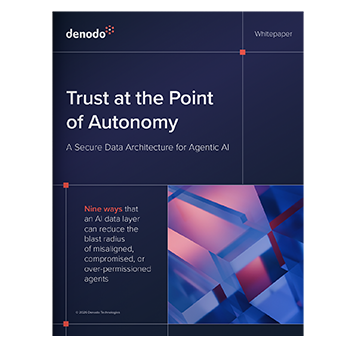

A Secure Data Architecture for Agentic AI
As agentic AI moves from answering questions to taking action, the security challenge changes. An autonomous agent can turn a mistake, manipulation, misconfiguration, or excessive permission into a material data risk.
Organizations cannot assume that every agent will always behave exactly as intended. They need an architecture that controls what agents can reach, limits the information exposed, and applies governance when each request occurs.
Build Trust Around the Agent
This whitepaper explains how an AI data layer can establish a governed boundary between autonomous agents and distributed enterprise data. It presents nine architectural principles for reducing the potential impact of misaligned, compromised, or over-permissioned agents.
Download the whitepaper to learn how to:
- establish the AI data layer as a security boundary;
- reduce the blast radius of unexpected agent behavior;
- apply consistent policies across distributed data sources;
- separate an agent’s reasoning authority from its data authority;
- enforce contextual, Zero Trust access decisions at runtime;
- make agent data activity observable and auditable;
- reduce credential proliferation across agent architectures; minimize the sensitive data exposed to AI models;
- and contain risk as agents delegate work across multi-agent systems.
Make Autonomy Safer to Trust
The goal is not to restrict the value of autonomous AI. It is to give agents room to act while the enterprise retains control of the data boundary.